Monday, March 17, 2014

Endings and Beginnings

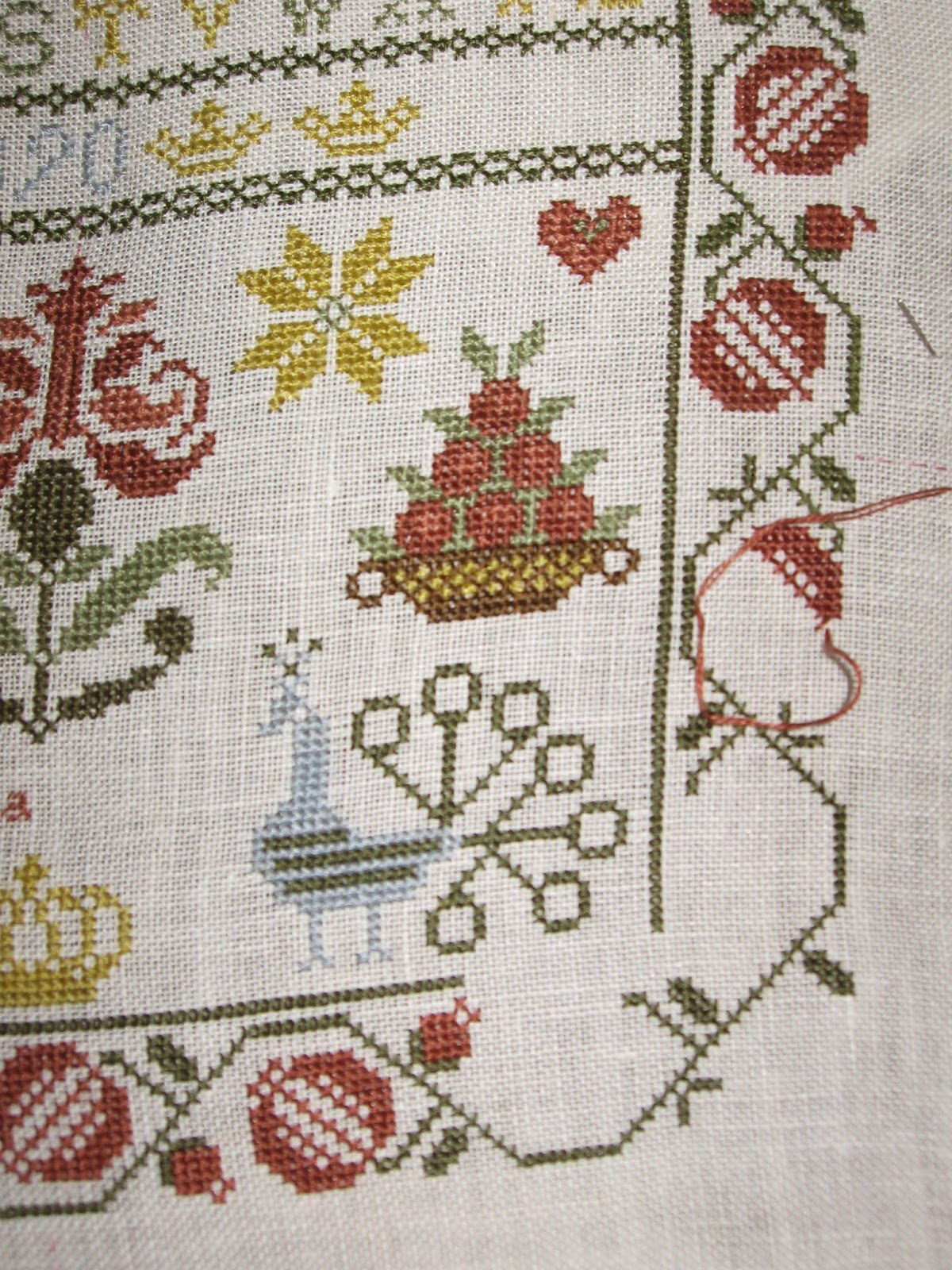
The loom is bare, the Easily Enjoyable Lace Scarf will be done any time I decide to cast off, and the end of the Pomegranate Sampler is in sight, so it is time to figure out - what next? The question is especially important as the orange trees are in bloom, and that lovely fragrance wafting through even closed doors means that the temperate temperatures will soon be over and the time of hunkering inside becoming one with the air conditioning will soon be upon us.
All that remains of the last of the "Getting Things Done" stitchery projects.
The options are many, but I've settled on a few. I've spent considerable time reading up on and studying an overshot pattern called Cross of Tennessee. It's a venerable old pattern, and attractive to me not the least because I am a native of the Volunteer State. I've never attempted this one before, so I've wound a 1 yard warp and put it on my little table loom - which, like this pattern, I've never tried before. So all of this is going to be a learning experience.
The little loom warped, waste yarn going in, just a few more shots before I can start finding out if this is going to work.
As far as stitchery goes, I'm planning to start no fewer than 3 pieces. There is a method to my madness - I'm aiming to have something reasonably easy, something moderately challenging but not crazy-making, and something that might have me tearing my hair out.

The easy pattern is one I've had for years, the Sarah Emerson Sampler by Gloria & Pat. I've had the linen and 6 skeins of dark blue DMC for years; this one really should have been on last year's "Getting Things Done List." It has several different kinds of stitches, but I've done them all before. That coupled with the single color has convinced me that it should be reasonably easy.
  For the "moderately difficult" piece, I saved my pennies and was finally able to order the DVD of 10 years' worth of the Sampler and Antique Quarterly. It has been a veritable feast and has kept me occupied for hours as I've perused articles and studied the patterns. With such a bounty, you hardly know where to begin, but I've selected a modest pattern from 2003 to try first, the "Hearts and Flowers Spring Sampler."  The overdyed threads and fabric may well arrive today, and I cannot wait. I haven't worked much with overdyed thread, and several of the stitches will be new, so it lands in the "moderate" category. But it's small, should work up to about 3" x 7 1/5, so it shouldn't make me crazy, and the variety of stitches and happy pink dogwood in the center were just too good to pass up.

The final one will be mostly cross stitch, but it's one I've designed myself, incorporating antique motifs and a wisecrack my Grandfather made, "If everybody liked the same thing, there would be a dreadful shortage of kumquats." I think I have done a good job of designing it, and thanks to Design Seed, I think I've made good color choices, but I won't really know what's going to happen until I start stitching. If it's like my "Crows" sampler, there will be much pulling out and reworking of stitches, and even a certain amount of drama before I'm happy. (In fact, I'm more than half planning to do a complete re-design of the Crows sampler one fine day.) I've a feeling I'm going to need to go back and forth between the professionally designed ones as I sort out all the problems I've made for myself on the original one!
Such a bad case of "almost but not quite..."
And finally, I'm tackling some more knitting. I have a beautiful skein of Blue Heron Yarn, Deep Water.  I've found a pattern on Raverly, The Age of Brass and Steam Kerchief, that I think will show the yarn off nicely but be simple enough that I'll have a chance of actually completing it.
Pretty colors - and sparkles too!
And that's how I plan to stay off the streets and out of the pool halls, for a while at least.

As in honor of the day, I'll leave you with my favorite Irish "blessing," which is probably as contrived as green beer, but I get a kick out of it.

"May those that love us, love us.
And those that don't love us,
May God turn their hearts.
And if he can't turn their hearts,
May he turn their ankles,
So that we'll know them by their limping."

And in the meantime....
Tuesday, December 31, 2013

Finishes, Major and Minor

The Valley Forge Dogwood scarf is finally off the loom, and I was mighty pleased with the results if I do say so myself. 

This is the pattern made me want to weave. Like the dogwood blossom it's named for, I cannot get enough.

Pick whichever ones makes you happy, and that's the "right" side.

This shot shows the two ends. I'm rather proud that the circles are fairly close in size, which means I was keeping my beat pretty even throughout the project. Pretty good, considering how long the thing was on the loom!


For those that keep track of these things, the piece is 5" wide x 6' long.The warp and tabby are 2/10 cotton, and the weft a lace weight merino yarn that I wound tripled. It's warped and woven 24 threads to the inch, and the pattern comes from the "Overshot Novelties" section of Marguerite Davidson's Handweaver's Pattern Book.

Got it into the mail and off to the biggest big sister just in time for Christmas.

The minor finish was finally framing a piece I've had for several years. Michael Everett (http://michaeleverettstudios.com/) is a Florida artist who does wonderful pencil drawings of Florida landscapes. I bought this print from him at a local art show. I've been wanting to frame it, but for some reason they don't seem to make the sectional pewter frames anymore; they've been on back order at several major suppliers for years now. So I got a black frame on sale and spray-painted it.

 It's still not the optimal frame for this piece - I miss having my professional framing buddy Jenn  from Jacksonville handy! - but at least I can get it on the wall.

And in the spirit of New Year's Eve, I leave you with this little ditty by Odgen Nash...

Tonight’s December thirty-first,
Something is about to burst.
The clock is crouching, dark and small,
Like a time bomb in the hall.
Hark, it's midnight, children dear.
Duck! Here comes another year!


Saturday, December 14, 2013

Frog is a Verb, Not a Noun

NOT the kind of frog I'm talking about.
I'm not sure where the term "frogging" came from, but for those who don't know what it means, it's when you pull a knitting project completely apart, wind the yarn back up and either completely give up or start over again. I'm told it comes from saying "rip-it, rip-it, rip-it" as you pull your work apart. There's been so much frogging at my house, you'd think we lived in a swamp.


I went back to work on the Wool Peddler's Shawl from Folk Shawls by Cheryl Oberle. First I had to do some un-knitting and re-knitting to get the stitch count right. But more trouble lay ahead. When I had started the project, I kntted American, not Continental Style. And I knit tight. So tight, that when I tried to purl the knits and knit the purls to begin the lace section, I could not get the needles into the stitches. So "rip-it, rip-it, rip-it" and start over again Continental style. Unfortunately, when I reached the point where the lace begins, something went very wrong very soon. I don't think third time is going to be the charm with this, so I'm going to take it to my LYS after the holidays and hope that I can just un-knit back to where all was well and get myself sorted out. I hope.

Off I went to a third project, the Lacy Prairie Shawl from Folk Shawls by Cheryl Oberle. And it just would not work. It's like I had a mental block about this thing. It's not that hard a pattern, but I was knitting it and ripping it out so much, I felt like I was in a time warp. I finally decided that the problem is that I've already one triangular shawl, the Garter Stitch Prairie Shawl from the same book in the exact same yarn, Cascades 220 Heather. I used it to teach myself garter stitch. So why am I making another triangular shawl in the same yarn from that book? So it is officially frogged. I bought all the yarn Oberle called for in her pattern, but stopped it well before the number of stitches called for - the thing was getting quite large, and I wanted a shawl, not a blanket! So I've plenty of yarn for another project. Which will not be another triangular shawl.

When you have this...


You don't really need this.

I went back to the Seriously Simply Shawl that I had started at a class a while back. No matter how I knit and un-knit, it just would not work. So I studied on the thing, and realized I had made a serious error fairly early on in the class. Nothing for it but to frog it. I re-started it several times, realized the pattern was actually asymmetrical, decided I didn't like it, and, well, "rip it, rip it. rip it."  It is well and truly frogged.

Back to the stash, until inspiration strikes.
  But all has not been lost. I got a ball of King Cole ZigZag superwash sock yarn off the sale rack a while back. It looked bright and fun, but proved to be very frustrating. I tried various patterns, but the colors pooled terribly and the projects were frogged. I finally tried the Easily Enjoyable Lace Scarf by Polly Macc, and it was just what the doctor ordered. The color variegation couldn't be falling more nicely, the pattern took about 3 repeats to memorize, and it has become the perfect waiting room/doctor's office project. I'd hoped to have it ready for Christmas. It's not quite there yet, but not to worry. We have a tradition in our family. We promise projects for Christmas, but we never specify which one!

This piece is not going to go bounding off the lily pad!


Sunday, July 28, 2013

Inch by Inch, Row by Row

That is how the garden grows, and that's how things are progressing here.

The Valley Forge Dogwood scarf progresses steadily and has passed the half-way mark. Had an interesting set back. I was happily weaving away, then realized things just looked off. Not unattractive, just wrong. I wish I'd had the presence of mind to take a picture of what I was getting, but it was late and I was plunged deep into that "What is wrong and what do I do about it?!" panic mode. I finally figured out that my pattern, which is from the Margaret Atwood book, has the treadling pattern written right to left, and my treadles are tied up left to right. I had been "stomping as writ," that is, treadling right to left. And yes, it was very late when this was happening, I should have been in bed hours before. Some artist's tape and a sharpie to remind me of my treadle order has solved the problem. I could re-tie my treadles, but not only would crawling around under that loom be physically painful, but I'm afraid I could mess up my loom for life because of the way the Wolf Pup's harnesses are hooked up to the treadles. The artist's tape solution is much easier.
Ana one, ana two, ana t'ree....

Once this scarf reaches length, if I've some warp left (The odds are good, I give myself lots of room on warps) I may re-treadle the "error" just for my records. The pattern I was getting was not unattractive, it was just not the Dogwood. But that's the fun of overshot. It's not any thing, it's just what it is. Like the Vulcan IDIC - Infinite Diversity, Infinite Combinations. (Gee, Star Trek and hand weaving; I wonder if anybody's ever gotten them in the same sentence before?)

When I took Art History in college, I annoyed the instructor when he announced that "op art" was a completely new was of dealing with color and shape and I asked if he'd ever looked at an overshot coverlet. He was not pleased when I brought him pictures and could show him that women in the hills and hollers of Tennessee and North Carolina were getting "op art" effects on their looms 100 years before Andy Warhol and his crowd came up with it. A quick browse through the 'net let me find this picture of a Double Bow Knot piece, probably woven early in the 20th century, though the pattern is much older. I couldn't find what I was looking for, a picture of a older coverlet where the weaver had used various colors in her warp and weft. The book Textile Arts from Southern Appalachia: the Quiet Work of Women has some marvelous examples of coverlets woven in the late 1800s and early 1900s that show a skill with pattern and color that would make a modern artist weep with envy if they would look at them. (A personal rant I will spare you because as someone who does "craft and "fine art" and  "illustration" I know I can far too easily start frothing at the mouth on the subject. Suffice it to say that it really annoys me that somebody can go on line, print out a bunch of black and white images, cut them into strips, paste the strips onto squares of foam core, piece the squares into a kimono shape with wire loops, hang them on a wire, enter them into a Fine Arts show and win a prize, while I can hand-spin silk, dye it, hand-weave the fabric, sew a kimono and not be able to even bring it into the same room as the foam core and glued-up printer paper because it is "craft." Grrrrrrrrr.....)
From HistoricWeaving.com, a piece that shows what my art professor assured me were uniquely 20th Century approaches to the use of color and form for "vibrational optical effect." Yeah, right buddy. 

I decided to re-visit Wendy Johnson's Seriously Simple Shawl that I started at a knitting class at my LYS in an attempt to learn to knit lace and read charts. Step One: figure out where you left off. First the stitch count was off. So I did a stitch-by-stitch reading and realized nothing on the chart corresponded with what I had on my needles. I finally figured out that while in class I had missed the center stitches, and had been doing so for  several inches. Nothing to do but start over again. Which meant going to You Tube to figure out how to do a tab start. So I started again. And promptly got into trouble again. And again. Sometimes the only thing keeps me sane is my conviction that you learn more about an art or craft when things go badly than than when things go well because it makes you really dig into how it all actually works. But then, there's also wisdom in the quote "If at first you don't succeed, try, try again. If you can't do it then, you may as well give up, there's no point being a damned fool about it." So that is now a ball of yarn and set aside for the time being

"Seriously Simple" is in for a serious wait.
So I went back to another start, the Lacy Prairie Shawl from Cheryl Oberle's Folk Shawl book. Her Simple Garter Stitch Prairie Shawl was the first major project I ever did - though I suspect it's about half the size it's supposed to be. When it got big enough I could almost sit on it - and I am not a short woman - I decided it was time to call it a day. (I really like the patterns in this book, but now that I've been working them, they seem awfully big to me, some of them nearly blanket-size. Has anybody else noticed this?) I still had about half the yarn I'd bought for the project left,  Cascade Heathers, a beautiful flecked green that reminds me of the rhododendron and mountain laurel on the Blue Ridge, so I decided to tackle the other prairie shawl.  When I took a closer look at what I'd done, I decided I was not happy with the lace, it looked lumpy to me. So true to form I've taken it apart and am started it on larger needles. I think my guess was right; I am happier with how it's coming together. That at the moment, I can only knit even the simplest lace by myself in complete silence with no distractions. It takes my complete concentration, even a cat going by is enough to mess me up!
Teah, the Queen-cat, plotting her next distraction
Ever onward....


Monday, May 20, 2013

The Little Dresser

Okay. I used to have a roll top desk. It was a lovely thing - probably the nicest piece of furniture in the house. But it was also a very large thing and I have to think back more than a decade to remember the last time I actually sat down at it and used it like, well, a desk. Mostly it held the bills and accumulated whatever miscellaneous pieces of paper that wandered in the door. So I've sold the thing to somebody who has coveted it for years and will actually use as a desk.. So to find a home for the various bits and pieces that were living in the desk, I bought myself a small dresser and refinished it.

The first step was actually the hardest. My usual thrift stores came up completely dry, then the second and third tier stores let me down. I even looked at some new ones. They wanted $70 and $110 for laminated chip-board junk I could twist with my bare hands. But the last store I stopped at, with an attitude more of "dotting the I's and crossing the T's" than any real hope, had just what I wanted - a small, simple wooden dresser. It had taken some hit points over the years, but it was sturdy and the price was right - $30.
I was sanding the first drawer when I realized I needed to get a picture!
I cleaned it up, and sanded it down.
I liked the handles, but one was missing, so all of them had to go.
I put 2 coats of MinWax Mission Oak PolyShades on it and added simple porcelain handles. It came out darker than I had really wanted, but it fits neatly in the home office. So I am a happy girl.
Pretty good for a first try in refinishing!
Heaven only knows what trouble this success is going to inspire me to get into!

Wednesday, May 8, 2013

More Finishes, Major and Minor

First, the Major. The Oak Tree Sample is done! It's not a large a piece, about 8"" x 4", but I am quite pleased with it. Seeing as I can't even remember when I started it, I also count it as a major check-off on the Getting Things Done list and that makes me feel good, quite important on a week that is proving to be full of thorns.
I made only one real change on it, swapping a little cross-stitch motif between my initials and name with a satin-stitched star that I thought picked up on the shape of the eight-pointed star motif above it.


I may hem-stitch the thing, partly because I've never done any hemstitching and it would be good for me to learn, partly because I prepared this piece of fabric back in the days when I was using iron-on hem tape and I think  it would be good to that stuff off the fabric and away from the sampler entirely.

The "minor finish" involves an over-due Christmas present. A while back they were handing out a free print at the local library of a painting by Diane Pierce, a Florida artist I admire hugely. I snagged a couple, thinking one would be perfect for my best birding buddy. When Micheal's had a half-price sale on picture frames, and I had a good coupon I could couple with it, I got a basic black frame. The thing would look like Buddy Holly's glasses on Diane's osprey's, so I got a couple of cans of Rustoleum's Hammered Gold spray paint and Bob's Yer Uncle, as they say.
The Frame, ready for its transformation.


A dry and a wet Fly-Lady Rag - my best pals!


I think the final result is quite splendiferous!
Two check-offs on my Things to Get Done List in as many weeks. Yoohoo!


Tuesday, April 30, 2013

First Finish of The Year! Or, The End of a Beginning.

You know how the natives in the Arctic are supposed to have something like 200 words for snow? I don't know if that's true, but I know for a fact that there are something like 150 different kinds of sand in Florida. Seriously. For real. We even have an Official State Sand - Myakka Fine, in case you're wondering. When you've got as much of the stuff as we do, you get to be something a connoisseur of silica before it's melted into glass. I'm not sure what the sand in my yard would officially be called. I've heard it called sugar sand, I've heard it called ball-bearing sand. But I know for a fact that it is the very dickens to find anything that can actually grow in the darn stuff. So when I find something that doesn't go belly up within a matter of weeks of being put into it, I get all excited. And so we enter into the saga of the Beach Sunflower. Or East Coast vs. West Coast.

Beach sunflowers are a Florida native. They do exactly what their name implies - grow on the dunes - and are well adapted to whatever Florida cares to throw at them. I got some a couple of years ago for the back, and was quite happy with them. They handled the heat, the sun, the sand, got bushy and strong and bloomed profusely. But the husband is from the MidWest and does not share my love for things that sprawl loosely and freely and trimmed them down with the idea they would grow back more neatly. Flowers are not shrubs, so I had bare ground again.

East Coast Beach Sunflower before Tom took the shears to it.
So I got myself some West Coast Beach Sunflower. Here Tom and I found a plant we could agree on. They bloom in all but the coldest weather and can handle the sun and heat and require little to no care, which makes me happy, and they stay low and form a tidy mass, which makes Tom happy. I had a chance to go to Pinellas County couple of weeks ago, so I got to by to my favorite nursery and get more West Coast Beach Sunflowers. Half of them went in the back to fill in the spaces left by the Great Sunflower Whack Job, and half in the front. I had to be careful to make sure I removed any remnant of the East Coast sunflowers since the two are closely related and when they cross, the taller, bushier East Coast variety is dominant.
Last year's  planting of  West Coast Beach Sunflower - Much tidier!
Then Sunflowers in the back will be growing in front of and around my Peggy Martin Roses, aka "Hurricane Katrina Roses." I set these out two and three years ago with hopes of having them climb the 3 center pillars of the pergola and get into the rafters a bit. They've started to do that, and well, you just have to love it when a plan comes together. Some of the canes have already hit the top 15' long mark and are draping prettily in the rafters. They have 2 really big blooms a year, but they bloom off and on in all but the coldest weather.I babied them a bit their first year; now I fertilize them about twice a year, water them occasionally during the worst of the dry season, and that's about it - you really do have to be tough to live in my world. But this is what they in return for that modicum of care. You just have to love these guys.

My Peggy Martin Roses
The story behind these roses is amazing. They came from the garden of a gardener name of Peggy Martin who lived in Plaquemines Parrish near New Orleans. Nobody really knows where they came from originally, but she was always glad to give cuttings to anyone who admired it. When Hurricane Katrina roared through, the Martin family was devastated; the flood waters swept away her parents, her home, her husband's commercial fishing boat. Her garden was under 20' of sea water for more than 2 weeks. When she was finally able to return, this rose was growing back. Inspired by its story, people who had these Peggy Martin Roses used cuttings from their bushes to help growers like the Antique Rose Emporium in Texas to sell these roses and donate part of the proceeds to a fund to help restore gardens destroyed by Hurricane Katrina. That is how I got my first two, and I was so impressed with how well they did that I got a third. You have to be tough to survive on my patch of ball-bearing sand, and these guys have the right stuff!
So delicate looking, but so tough.
The front yard has been a whole other battle. There had been a yew hedge in front of the house, but it had gotten tattered and scraggly, so we'd had it taken out and replaced it with plumbago last spring - another plant which has done well for us. We also planted a Cracker Rose, an antique species rose. I've another in the yard, great plant in completely the wrong spot. It did not read the part of the book where it's supposed to top out between 4 and 6 feet; I think it wants to be 8 feet or so. I have to keep cutting it in half so we can see out the dining room window. I'm afraid that one will have to go. But you have to love a plant that does so well in such hostile territory, so I've sited another Cracker Rose where it can get as big was it wants to be. Once the Beach Sunflowers spread out in front of the plumbago and new Cracker Rose gets some size on it, this space should look a lot nicer.
These babies have a lot of growing up to do!
So bit by bit we're getting the yard a bit more up to snuff - though we have no intention of ever having one of those perfectly manicured St. Augustine grass ChemLawn things some of the neighbors have. Our yard will never look like the greens of Augusta. But as long as it doesn't bear too close a resemblance to the first turn at Churchhill Downs, we're doing okay!